
Vauxhall Pleasure Gardens: Glamour to Greenery
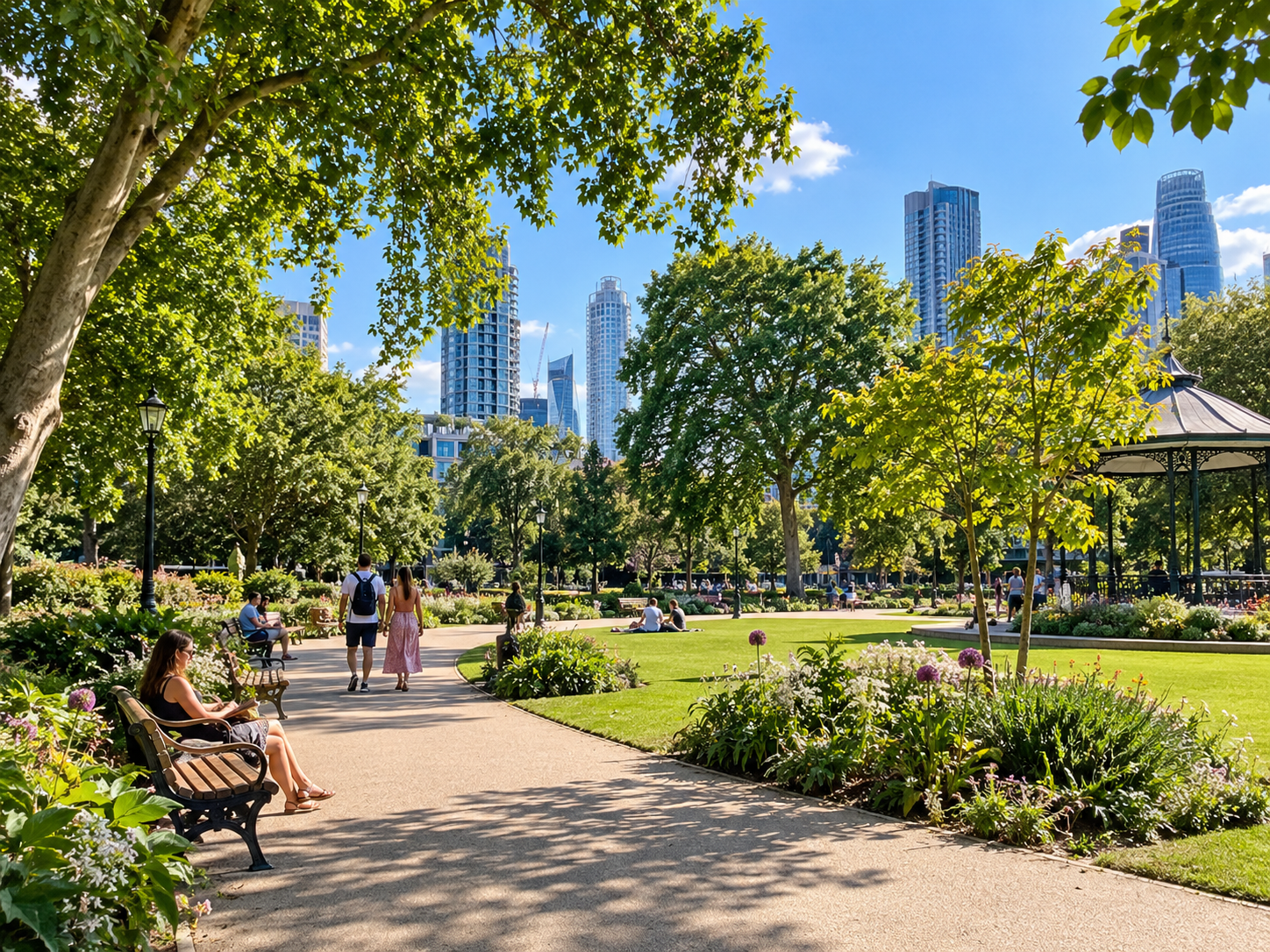
Once one of London's most fashionable entertainment destinations, Vauxhall Pleasure Gardens has a history of music, fireworks, spectacular parties and more than a little scandal. Today, it's a welcome green space in the heart of Vauxhall — but its extraordinary past is still part of what makes it special.
One of the things I find particularly interesting about living around Kennington and Vauxhall is just how much history is tucked away in places you might otherwise walk straight past.
Vauxhall Pleasure Gardens is a perfect example.
Just a few minutes from Vauxhall station, surrounded by busy roads, railway lines and an increasingly modern skyline, is a sizeable public park that provides a welcome bit of greenery in the middle of SE11.
At first glance, it's a pleasant enough place to walk, sit in the sunshine or escape the surrounding traffic.
But what makes it particularly interesting is that this was once one of the most famous entertainment venues in Europe.
And we're not talking about the occasional summer concert.
For nearly two centuries, Vauxhall Pleasure Gardens attracted London's fashionable society with extravagant performances, illuminated gardens, fireworks, food, music and all manner of entertainment.
In many ways, it was the Georgian equivalent of a major entertainment complex.
And its story is rather more colourful than you might expect.
When Vauxhall Was London's Place to Be
The story begins in the seventeenth century.
The original gardens, known as New Spring Gardens, were established around 1661, during the reign of Charles II.
At the time, this part of London looked very different.
Vauxhall was still relatively rural, sitting south of the Thames and well away from the densely developed streets of the City and Westminster.
Visitors could travel across the river by boat, arriving for an evening of dining, strolling and entertainment among the trees.
The gardens attracted a surprisingly fashionable crowd, including members of the aristocracy, writers and prominent London society figures.
Samuel Pepys famously recorded visits to the gardens in his diary.
And while the early attraction was largely the opportunity to enjoy the gardens and socialise, the venue would eventually become something far more elaborate.
Its transformation really began in the eighteenth century.
Jonathan Tyers and the Birth of the Pleasure Gardens
In 1728, entrepreneur Jonathan Tyers took over the gardens and began developing them into a much more ambitious attraction.
Working with artists and designers, including William Hogarth, he transformed the site into a fashionable destination filled with music, art, architecture and carefully designed entertainment.
By the 1730s, Vauxhall Gardens had become one of London's most celebrated places to spend an evening.
Visitors paid admission to enter a world of ornamental gardens, illuminated walkways, decorative pavilions and live performances.
The grounds were famous for their outdoor dining areas, where people could enjoy supper while listening to music.
There were elegant promenades where fashionable Londoners could see and be seen, alongside darker, more secluded walks that developed a reputation for somewhat less respectable activities.
And that mixture of sophistication and mild scandal was very much part of the appeal.
It's rather amusing to imagine the Georgian aristocracy making their way down to Vauxhall for what was essentially a fashionable night out.
The clothes might have changed, but the idea of heading somewhere for good company, music and a lively atmosphere feels remarkably familiar.
Music, Fireworks and Extraordinary Entertainment
What made Vauxhall Pleasure Gardens particularly impressive was the sheer scale of its entertainment.
The gardens became famous for elaborate lighting displays, with thousands of lamps illuminating the trees and pathways after dark.
There were orchestral performances, singers, concerts and theatrical spectacles.
The composer George Frideric Handel was closely associated with the gardens, and his music featured prominently in its entertainment programmes.
And then there were the fireworks.
By the late eighteenth century, elaborate firework displays had become part of the attraction, drawing enormous crowds.
Hot-air balloon ascents followed in the nineteenth century, alongside acrobatic performances and increasingly ambitious spectacles.
One of the most extraordinary aspects of the gardens was their ability to combine so many different experiences in one place.
You could enjoy a concert, admire artwork, eat supper, walk among illuminated trees and watch a spectacular entertainment display, all during the same evening.
It must have been quite an experience.
And it makes today's occasional outdoor cinema screening seem wonderfully restrained by comparison.
A Little Scandal Was Part of the Attraction
Of course, the gardens weren't entirely about respectable entertainment.
They also developed a reputation for flirtation, romance and encounters away from the watchful eyes of Georgian society.
The famous Dark Walks, where the lighting was deliberately more subdued, became particularly associated with couples looking for a little privacy.
Writers and commentators of the period frequently remarked on the contrast between the elegant public promenades and the rather less formal activities taking place elsewhere.
The gardens attracted an interesting mixture of social classes, too.
Although admission charges meant they weren't equally accessible to everyone, Vauxhall offered opportunities for people from different backgrounds to mingle in ways that were less common in everyday Georgian society.
There was music, fashion, socialising and occasionally behaviour that raised a few eyebrows.
In other words, Vauxhall had a lively nightlife long before the modern bars and clubs arrived.
Some things clearly never change.
How the Original Gardens Disappeared
Despite their enormous popularity, the gardens eventually began to decline during the nineteenth century.
London was changing rapidly.
New entertainment venues, music halls, theatres and public attractions were competing for visitors.
The arrival of the railway also changed the surrounding area dramatically.
What had once been a relatively secluded destination became increasingly urban and industrial.
The gardens struggled financially and passed through several owners before finally closing in 1859.
The site was subsequently sold and redeveloped for housing.
Over time, almost all physical traces of the original pleasure gardens disappeared.
It's quite extraordinary to think that one of London's most famous entertainment venues could effectively vanish from the landscape.
But fortunately, that wasn't quite the end of the story.
From Spring Gardens to Vauxhall Pleasure Gardens
Following damage during the Second World War and subsequent clearance of deteriorating housing, the area was eventually transformed into public open space.
The new park opened in 1976, initially under the name Spring Gardens.
It was a considerably more modest place than its Georgian predecessor, with lawns, pathways and trees providing a much-needed recreational space for local residents.
But in the years that followed, the park began to reconnect with its extraordinary past.
Local campaigners, particularly the Friends of Vauxhall Pleasure Gardens, worked to protect the space and improve its facilities.
In 2012, following improvements to the landscape, the park officially reclaimed its historic name: Vauxhall Pleasure Gardens.
The modern entrance near Kennington Lane features two striking 18-metre columns, designed to evoke the grandeur of the original pleasure gardens.
They're a rather fitting reminder that this wasn't always simply an ordinary public park.
A Green Space in the Heart of Modern Vauxhall
Today, Vauxhall Pleasure Gardens offers something quite different from the elaborate Georgian entertainment grounds.
There are open lawns, mature trees, walking routes and space to relax.
It isn't quite the same kind of formal landscaped park as Kennington Park, and that's part of its appeal.
It feels more like an open neighbourhood green space, somewhere people can walk through on their way to work, spend a bit of time outside or meet friends.
The park also sits within one of London's most rapidly changing neighbourhoods.
Vauxhall's modern residential towers and commercial developments create a striking contrast with the older streets and historic buildings surrounding the gardens.
And despite being incredibly close to central London, there's something reassuring about having this much publicly accessible green space.
It's particularly valuable in an area where many homes are apartments and private outside space isn't always available.
There's Even a City Farm Next Door
One of the nicest surprises around Vauxhall Pleasure Gardens is Vauxhall City Farm.
Established in 1977, the farm sits alongside the park on Tyers Street and is a rather unexpected attraction to find so close to central London.
It's home to a variety of animals, alongside educational programmes, community activities and opportunities for children to learn about farming and animal care.
There's also a riding centre and an on-site café.
It's a lovely example of how the area offers something beyond the obvious attractions of central London.
You can be surrounded by high-rise developments and busy transport connections one minute, and visiting a working city farm the next.
And that's quite a contrast.
Summer Events Bring the Gardens Back to Life
Perhaps the nicest connection between the old and new Vauxhall Pleasure Gardens is that the park still hosts public entertainment.
While we might no longer have Georgian aristocrats wandering through illuminated avenues, the tradition of bringing people together for music and outdoor events has survived in a modern form.
The Vauxhall Summer programme is a particularly good example.
In recent years, it has brought free outdoor cinema screenings, karaoke and community entertainment to the gardens.
The 2026 programme included Vauxhall Summer Screens, with open-air film evenings throughout July featuring Zootropolis, Cool Runnings, Clueless and Mamma Mia!.
There's also Bearpit Karaoke, which brings a rather different kind of live entertainment to the gardens.
The event encourages members of the public to get involved in an open-air singalong, with the audience becoming as much a part of the entertainment as the performers.
It's a wonderfully informal idea, and in some ways feels quite appropriate for a location with such a long history of public spectacle.
The park also provides space for community gatherings, cultural activities and other local events throughout the year.
For upcoming programmes, it's worth checking Vauxhall's local events listings and the Friends of Vauxhall Pleasure Gardens.
A Neighbourhood With More Character Than People Realise
Something I've noticed about Vauxhall is that people who don't know the area particularly well sometimes think of it primarily as a transport interchange.
They associate it with the station, the busy road junction, the buses and perhaps the modern towers around Nine Elms.
And while those are certainly part of Vauxhall, they don't tell the whole story.
There are some genuinely interesting residential streets, historic buildings, independent cafés, pubs and community spaces within a few minutes' walk.
Bonnington Square, with its extraordinary community garden and Italo Deli, is one example.
The historic Royal Vauxhall Tavern, sitting beside the entrance to the Pleasure Gardens, is another.
And then, of course, there's the park itself.
It's this combination of modern development, local history and community life that gives Vauxhall a much more individual character than people might initially expect.
Why Green Spaces Matter When Buying a Home
When I'm discussing a property with prospective buyers, outside space is often fairly high on the list of priorities.
Understandably so.
A balcony, terrace or garden can make an enormous difference to how someone enjoys their home.
But in London, particularly around more central locations like Vauxhall and Kennington, not every property comes with private outdoor space.
That's where the surrounding neighbourhood becomes particularly important.
Having somewhere green within walking distance can make a real difference.
It's somewhere to get some fresh air, enjoy a sunny afternoon, walk the dog or simply spend a bit of time away from home.
And when that green space also has a fascinating history and a programme of local events, it's an added bonus.
That's one of the reasons I like writing about these places alongside the homes we're marketing.
A property listing can tell you how many bedrooms an apartment has and how far it is from the nearest Tube station.
But it doesn't always show you what living in the neighbourhood actually feels like.
For anyone considering a home around Vauxhall Grove, Kennington Lane, Oval or the surrounding streets, Vauxhall Pleasure Gardens is another example of what's available right on the doorstep.
From extravagant Georgian entertainment to relaxed summer evenings in the park, Vauxhall Pleasure Gardens has been part of London's social life for centuries — and it's rather nice that local residents can still enjoy it today.
Visiting Vauxhall Pleasure Gardens
You'll find Vauxhall Pleasure Gardens off Kennington Lane, London SE11 5AW, a short walk from Vauxhall Underground, National Rail and bus stations.
The park is free to enter and provides open green space, walking routes and recreational areas.
Vauxhall City Farm is located beside the gardens on Tyers Street, while the Royal Vauxhall Tavern stands close to the park entrance.
Throughout the year, the gardens also provide a setting for local community activities and seasonal events.
For more information, visit:
Friends of Vauxhall Pleasure Gardens: www.fovpg.com
Vauxhall City Farm: www.vauxhallcityfarm.org
What's on in Vauxhall: www.beinvauxhall.com
